
“My journey begins and ends with mental health challenges. From my standpoint, there’s no shame in that. I’m happy to have that information out, to share about the challenges I’ve faced and the help that’s out there,” said Dennis Dee, Executive Director of the Father McKenna Center. “If I hadn’t had some of the struggles that I had, I wouldn’t be in a position to help the people I’m helping now.”
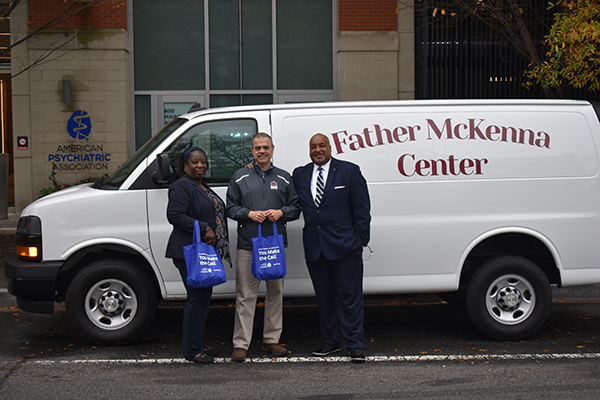
The Father McKenna Center is a 501(c)(3) founded in 1983 and located in the heart of Washington, D.C., whose mission is to serve men struggling with homelessness and families experiencing food insecurity. The organization memorializes Fr. Horace McKenna, SJ, who is responsible for the creation of several other D.C. organizations that support low-income and underserved communities (including Martha’s Table and So Others Might Eat).
When Dee was in grade school, his undiagnosed ADHD presented behavioral difficulties in the classroom that were accompanied by negative reinforcement. He went on to graduate from Georgetown University with a bachelor’s degree in 1986 and then a Juris Doctor in 1989. He began climbing the corporate ladder, eventually building a career at investment banking firms on Wall Street, and seemingly “had it all.” On the inside, however, Dee struggled with alcohol use and what would eventually be diagnosed as manic depression. In 2012, Dee’s life took a turn for the worse. He lost his prestigious, seven-figure job. His wife filed for divorce. Eventually, he found himself unhoused and sleeping on park benches in Florida.
Two years later, Dee visited the McKenna Center for the first time and quickly became a regular guest. He began working with a case manager and waiting tables at Denny’s as he focused on his recovery. Before long, Dee was hired as a staff member at the McKenna Center and eventually became a case manager himself. In 2016, Dee began working as an addiction counselor at the Haymarket Center in Chicago. Seven years later, while serving in that role, the Chair of the McKenna Center’s Board of Directors contacted Dee to begin the executive director interview process.
“I am blessed that my personal journey allows me to connect with our guests – I'll never get too far away from my experience of homelessness because I literally stayed in the shelters that our guests stay in now,” said Dee. “Today, I have more of a pastoral role with the men coming into the Center. It’s not unusual for me to do the name tags or the check-in in the morning, to set the tone for the day: start off with a smile and ask how they’re doing. Approximately 500 different unhoused men and 500 different families receive food pantry assistance from the McKenna Center each month. I like to say that we serve a community of roughly 1,000.”
On an average day, the McKenna Center serves breakfast and lunch to roughly 160 men and provides 35 to 40 households with groceries. Their paid staff of eight is supported by over 1,200 volunteers per year, many of whom are high school or college students, who provide over 14,000 hours of unpaid service yearly. Now living with his wife in DC’s West End neighborhood, Dee combines his history as an addiction counselor and the McKenna Center’s roots in Ignatian Catholic social teaching to serve guests as a de facto mental health counselor. “Even though I didn’t have a university degree specifically in mental health, I am able to share with clients the various resources that have helped me with my mental health challenges and ongoing recovery from addiction,” he said. But Dee credits nutrition services as the most vital element of his organization’s mental health work.
“Fr. McKenna once said that ‘you can’t talk to a person about his or her soul if that person has no food.’ Incorporating Maslow’s hierarchy of needs, the more variables you can stabilize in terms of physiological needs, the better chance you give a person for their mental health to stabilize,” said Dee. “If we’re able to provide food for our guests and they know that’s taken care of, then they know that for the rest of the day, they can take care of their business, get to appointments, and not have obtaining a meal as a priority.”
Individuals with lived experience are uniquely qualified to lead mental health service organizations – and when homeless neighbors with serious mental illness are treated with dignity, they have the freedom to explore new approaches to recovery. The American Psychiatric Association Foundation is a proud supporter of the Father McKenna Center’s food security and mental health initiatives. If you’re interested in becoming an advocate like Dennis Dee, download our Mental Health Guide for Faith Leaders at no cost. To learn more about the McKenna Center, visit their website.