
This resource's creation was supported by the 2025-2026 APAF Justice Fellows Workgroup.
The U.S. Bureau of Justice Statistics (BJS) estimates that approximately 600,000 people are released from state and federal prisons each year, with an additional 9 million people cycling out of local jails [1]. After an individual has been incarcerated, they face a number of challenges as they re-integrate back into society beyond the correctional setting. They often encounter obstacles accessing stable housing, education, employment, physical and mental health care, and substance use treatment. A criminal record may render individuals subject to discrimination and prejudice in nearly every domain of life, therefore increasing the risk of recidivism (i.e., returning to the correctional system). According to a 2021 BJS report, approximately two-thirds of individuals released from state prisons in 2008 were arrested again within 3 years of release, and this figure increased to 82% when considering the 10 years following release [2].
Adequately addressing reentry needs is a critical means of minimizing the risk of recidivism. Several models of care have been developed to help facilitate formerly incarcerated individuals’ reentry into the community, such as the Sequential Intercept Model, which outlines a series of “intercepts” at which resources and supports can be provided [3]. Various types of reentry programming exist at the federal, state, and local level, to meet the unique needs of this population, with key aspects including assistance with housing, employment, reunification with family, and connection to health care.
This last post shares the stories of eventual reintegration into society following release from carceral settings.
Rooted in the Brown v Board of Education Era
Mr. Jefferson: I came home in 2019. I've been home for about seven years now, and I'm still adjusting. When I came home, I had two life sentences without parole. Both of those sentences were illegal, but it took 15 years to get the time back. I didn't get clemency from a president. I had to fight. It's been a fight. I've been fighting all my life. When I was finally released in 2019, I was already about 70.
Mr. Jefferson: Here I am again, written off. Although I'm coming home with even more skills, the age discrimination card is against me.
Mr. Jefferson: Once they see my age on the resume, they haven't even met me, but just on paper, they wonder why I should even be there. Maybe people doing the interview are thinking, 'This guy is old enough to be my grandfather. Does he really know how to do this?' I was behind the curve on some of the technology, but now I've pretty much got it down, seven years later. But it's still an adjustment.
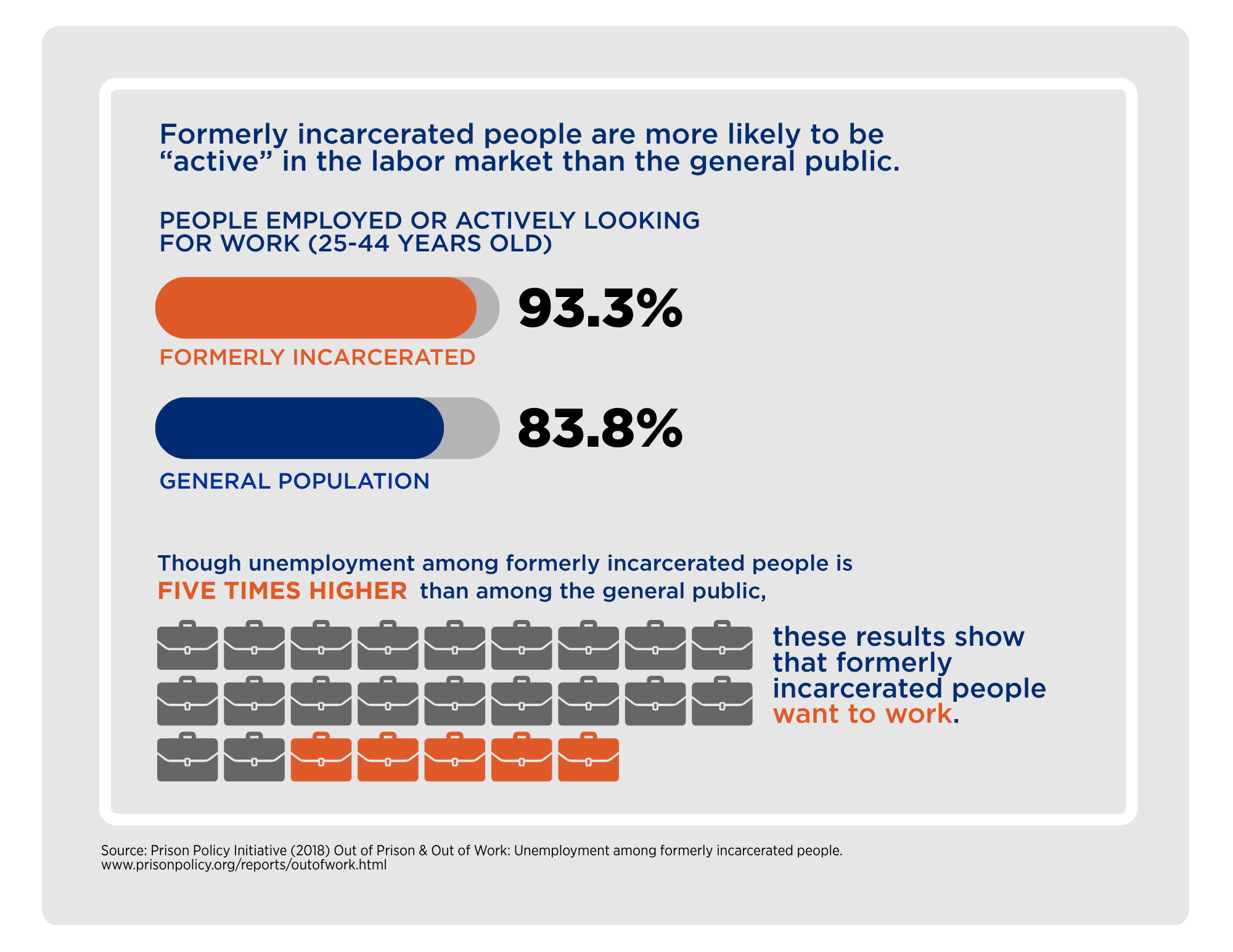
Employment and labor force participation
Among people ages 25–44, the percentages employed or actively looking for work are:
| Population | Employed or actively looking for work |
|---|---|
| Formerly incarcerated people | 93.3% |
| General population | 83.8% |
The infographic reports that unemployment among formerly incarcerated people is five times higher than among the general public, despite their higher labor force participation. It emphasizes that formerly incarcerated people want to work.
Source: Prison Policy Initiative (2018), Out of Prison & Out of Work: Unemployment among formerly incarcerated people.
Mr. Jefferson: I see silent age discrimination, even within certain programs. Once you've secured a spot, you kind of get pushed out because of age. And you're not taught anything about Medicaid, Medicare. People ask, 'Why don't you have this?' I turned 65 in prison. It doesn't even apply to a person serving life; it's not even relevant. First, you have to know that you're getting out, have a release, have a plan.
Mr. Jefferson: It's more difficult to compete with a younger person who can promise a company five or ten years. Then they think you might need more skills, you might get sick, the insurance costs. This is real. I had to just make my own way. Over 76 years, it's probably hard to tell my story in an hour.
Interviewer: Is there anything we've not talked about that you wanted to say or have me incorporate?
Mr. Jefferson: I think family is a good part, the supportive part. A lot of times when you're away, your family, the men and women, your relatives, your cousins, the people you have family dinners with on occasions: everybody has grown up. Everybody has children and grandchildren and great-grandchildren. A person that has suffered long-term incarceration like myself, you miss all of that. You don't even know who some of these people are. They don't know who you are.
Mr. Jefferson: There are sensitive stories even dealing with family, because they think, 'He's been getting in trouble all his life.' The confidence there sometimes is lacking. Sometimes it is supportive. But basically, you have to figure it out. Most programs are geared toward young people, like when I was a juvenile, programs that I really didn't get. So now that I'm a senior citizen, a senior with a long criminal history, past retirement age, what do you do with people like me? That's the question. We're still alive. We still have life in us. I want to do some things.
Interviewer: And where were the men in your family growing up? How did it end up just being the women?
Mr. Jefferson: Because of the divorce. My father died in the military; he was a sergeant. Then my mother got married, and that marriage ended in a divorce when I was maybe seven. My mother's sister's husband died. Remember, the lifespan of Black men is probably among the lowest in the country statistically. We're more prone to colon cancer, heart disease, high blood pressure, all the stuff that shortens a person's life.
Mr. Jefferson: The males died off. On my cousin's side, one was a dentist out of Vietnam. He turned to drinking when he came back and died in his 40s. He was like a big brother to me. Other than that, the male figures in my life were actually boys in the street, like me, that you gravitate to in order to learn how to be a man. And then being incarcerated in institutions, that's where you have to learn to survive, how to be a man. Or else you're going to be somebody's victim.
Mr. Jefferson: There is one point that we omitted. There's also a mental health aspect. I have been exposed to psychiatrists in the early years because I was committed to a federal state psychiatric hospital. My mother felt that maybe I was suffering from some mental problems. So I was committed there, and that was another institution experience. I think it was around 1965 or 1966. I was put in for observation a couple of times.
Mr. Jefferson: I'm around all these people with all these problems. I meet the psychiatrists, and they talk to you. Even as a young person, I see the sexual predators, the activity, the danger. The two chief psychiatrists were women. This was my first experience being examined, stripped down for a physical by a woman. I'm afraid for myself because I'm in one of the most premier psychiatric institutions in the country, though I didn't know that at the time.
Mr. Jefferson: I'm also being locked down when I'm being recalcitrant. I'm locked down, kicking on the doors. Have you ever seen that movie, One Flew Over the Cuckoo's Nest?
Mr. Jefferson: It's a place you want to get out of. It doesn't seem like a place that you want to be in. And I was there.
Interviewer: Again, a structure of control. Anytime you stepped out of line, you were being reprimanded strongly and put back in your place.
Mr. Jefferson: Yeah, and remember, I came up in the era of straitjackets. Luckily, I don't recall one being put on me. That was one of my biggest fears: being confined and being put in a straitjacket. But being in those rooms by yourself, constantly, for so many years of your life, I probably am still suffering in some kind of way right now and don't even know it.
Mr. Jefferson: I tried to emulate being a psychiatrist, because I saw how patients were interviewed, and then how they interviewed me and talked to me, gave me my physical, my mental evaluation. I saw the way they approached things.
Shaped by the War on Drugs
Interviewer: What was it like adjusting to life outside when you got to the end of your run?
Skip: Well, first of all, I never adjusted because I would leave jail and go into a shelter system, which was really just a smaller microcosm that looked like a jail. What changed for me is, I was finally given a program that worked with both sides of me. I was finally introduced to the idea and concept of recovery, and that I could get it.
Skip: When you label us and tell us we're no good, we can't do this. I call it being part of the “never, woulda, coulda” club. I heard that all my life. When I finally got to a place that showed me and taught me that I could, and that I was worthy, that's when I flourished. That's when I went into recovery. Not just recovery from substances, but also recovery from mental illness.
Skip: So the labeling theory is real and it works. If you keep labeling me as a drug addict, as a seriously persistently mentally ill, chronically homeless - I'm gonna stay like that. But when you show me that I can do better, that I am better, then I can flourish.
Skip: Recovery is possible for anyone. Look at me today. I've been clean since 2007. I've been free from any justice impacts since 2007. Am I still impacted by the justice system? Yes, I am. But you know what? I work in criminal justice reform and transformation. So that's my impact now.
Skip: I am building a system where they don't build any more Skips.
Interviewer: Were there any other support services besides this program that were available to you upon release?
Skip: Not until the end. They did the best thing they could ever do. They took me out of New York City, which is my stomping ground.
Skip: So, the thing about people, places, and things really works. And we talk about places: I couldn't get clean living in a shelter amongst the same people doing the same thing. So, you took me out of the city, and you brought me all the way out to Suffolk County, where I learned a new way of living.
Interviewer: And what is life like for you now?
Skip: Oh my god, life is gorgeous. I'm waiting on my acceptance into the PhD program. I'm either going for a PhD in criminology or a Doctor of Criminal Justice, so I'm deciding between that. I graduated with a Master's with distinction in Criminology. I’m academically published. I have some peer-reviewed journal articles under my belt. I still continue to write. My organization is flourishing. I'm the vice chair of the New York City Board of Correction.
Skip: I teach at a community college. I was introduced to peer support when I first came home in 2007, and I'm like high up in the food chain as far as peer support. I'm the originator and the founder of the New York City Justice Peer Initiative, where I took my lived experience of having behavioral health concerns and being in the criminal justice system and I built the idea of a justice peer, which works with people to achieve recovery and successfully do reentry and successfully negate the stigma of being justice-impacted.
Interviewer: What has it been like for you to see other people turn their experience around?
Skip: We are part of a cadre of those who have taken our personal lived experience and turned it into professional lived expertise.
Skip: Right now, I'm very dangerous. Why am I dangerous? Because I have practical knowledge, because I walked it. And I also have theoretical knowledge, because I went back to school to learn the theory. Because once I was introduced to recovery, I took off. But it's how you introduce it, and what you give us as we're coming through the system. And if I can do it, anybody can.
Interviewer: What advice do you have for mental health professionals about how we can be most supportive and see you?
Skip: See the person, not the diagnosis. You need to be trauma-informed. It's not strictly about what you did. No, what you should be saying is: “What happened to this person? What did this person not get that led them to this point?”
Skip: When I first started this work, nobody talked about lived experience. Now, everybody's talking about lived experience, but you need to elevate that thinking and move that lived experience to professional lived expertise.
Lessons From the Modern Era
Mrs. Poe: After I left jail, it was hard for me to really… really live my life, you know, because… I was just a person who went to jail, and that's how everybody defined me. Even though I was never prosecuted for drug use, the charges for fighting my sister would always be brought back up.
Mrs. Poe: So, when I was released. The only support that I had was my mom, but I ended up losing that support too. Even though my family helped me out, I was still getting high on the job, and it took a whole year of me being sober and clean for my family to start trusting me again.
Mrs. Poe: So was there any support back then? No. There wasn't. Not even in jail. There was none. They used to say, “oh, you know, you can go back to the program or whatever,” but… there was no community support.
Interviewer: Was there anything that led to that final turning point that made you want to get clean in the summer of 2015?
Mrs. Poe: Yes, I tried killing myself – I shot myself up with bleach. Because I wanted to just die. It was my daughter who woke me up. She said, “When are you ever gonna get your life together?” She was like 7 or 8 years old. I just sat there, and I'm like, I need help, I cried all night.
Mrs. Poe: I reached out to my mom, and I told her I wanted to go to the 12-step program of AA. But even in AA, I would get into trouble. My mom didn’t want me to go to AA for a time because AA would give me ideas about using. But in the end, I did stick with AA, and I did change my life around.
Mrs. Poe: Ten and a half years later, I am working in corrections. I'm on the other side of that. I am a peer recovery specialist. I'm on my way to get my recovery support specialist certification and my addiction counseling certification. Because I realized what I needed was peer support.
Mrs. Poe: If someone in the court has lived this life, they could have helped get me through. Because… I didn't hear them - not the judge or my case manager - because how can you. How can you tell me what I'm going through when you have no clue. You have no clue how broken I was and what had happened to me. I wish I had a peer… a peer recovery specialist.
Mrs. Poe: When I was in drug court, I did have to go to counseling. I had to go to group, and even then, I lied. I was under the influence. So when I finally got clean and sober, and I decided to change my life around, I started working with horses, which I was very afraid of. This led my family to see the change in me. I continued down this path, and then I found out that a program was going to get started in corrections. I've always wanted to work in corrections; I've always wanted to work with inmates and try to help them as they re-enter society because of my experience. I decided to get my peer recovery specialist certification. Then through my work, I was at a community meeting, and I ran into my former case manager from drug court. It's so weird, because now I'm on the other side, and she's asking me to go somewhere with her, which is… weird, because in the past, that meant I'm getting sanctioned. That's how I got involved in a program that actually works in the jail with inmates one-on-one as peer recovery specialists.
Interviewer: It must be remarkable to see that process and see how much you've grown.
Mrs. Poe: Yes, yes, it's been amazing. I was very emotionally immature back then, and I didn't realize that. There were all the traumatic experiences that I had where I just stayed there. So anytime I was triggered, I would act like that 8-year-old little girl that wasn't able to get out. I can tell you the 12-step program helped me a lot. If it wasn't for the 12-step program, I wouldn't be where I'm at, and I wouldn't have the relationship that I have now with God. And that's why I try to encourage inmates to get into a 12-step program. It helps being around others that have gone through what you've went through.
Mrs. Poe: I still have a sponsor, I still go to AA, I have become a sponsor myself.
Interviewer: Awesome. What's life look like for you in your time outside of work?
Mrs. Poe: I was sober 3 years, when I met my husband, we got married a year and a half later. He has two kids of his own, so combined, we have 6 kids, and um…We've been married going on six years now. My kids are doing well. I am a youth volunteer in our church. I am an ordained chaplain. I volunteer with homeless shelters, too. Church and staying active is really important to me as well.
Interviewer: Sounds like you have a very, very full life.
Mrs. Poe: My home life is great. I think that with all the trauma that I have been through and the jails and the institutions. It has been my greatest gift because I do see grace. I do see mercy, I do see love, and through it all, strength.
Mrs. Poe: I feel like now that I've been on both sides. It's just empathy and compassion. I think they want to be understood, more than told what to do, you know? When I was sitting in front of, you know, doctors and therapists all I wanted them to do was hear me, you know. I felt judged a lot. I just wanted to be heard, because I wasn't. I wasn't heard.
Mrs. Poe: I love that you all are willing to look at and really see how you can change, how everybody, how the whole system can change. Because there are ways to do that, like being more compassionate. There's underlying issues why people keep on going back to what they're used to. They're in pain, they're hurting. I think what APAF is doing is great, I believe that you all are on the right path as far as wanting to know more and how to help and support people like us.
Mr. Jefferson, Skip, and Mrs. Poe’s stories offer three unique perspectives on the ways in which the criminal justice system profoundly alters the course of people’s lives. While sharing common themes, each narrative also highlights how historical, political, and societal influences have shaped different eras of reform. Importantly, their journeys show us how justice involvement has widespread implications not only for individuals but also for entire communities and society at large. They share their stories in the hope that policy may reflect on real lived expertise.
We, the APAF Fellows, thank them for their courage and generosity in sharing their very personal histories.
The APA Foundation’s mission is to create a mentally healthy nation for all – where we live, learn, work, worship, and play. To learn more and become involved in the APA Foundation’s Justice branch of work, visit the Judges and Psychiatrists Leadership Initiative homepage. To support the early identification of ACEs and change outcomes for individuals like Mr. Jefferson, Skip, and Mrs. Poe, you can make a gift to the Foundation by texting APAF2026 to #44321.
References
- U.S. Centers for Disease Control and Prevention-Correctional Health.(2024, February 5). Providing Support for Reentry for Formerly Incarcerated. https://www.cdc.gov/correctional-health/reentry/index.html
- U.S. Department of Justice- Office of Justice Programs. (2020, August 13). Reentry-Special Feature. https://www.ojp.gov/feature/reentry/overview
- Substance Abuse and Mental Health Services Administration. (2024, May 24). The Sequential Intercept Model (SIM). https://www.samhsa.gov/communities/criminal-juvenile-justice/sequential-intercept-model